Titan Makers: Reconstruction of a Missile Silo as Post-Carbon Infrastructure
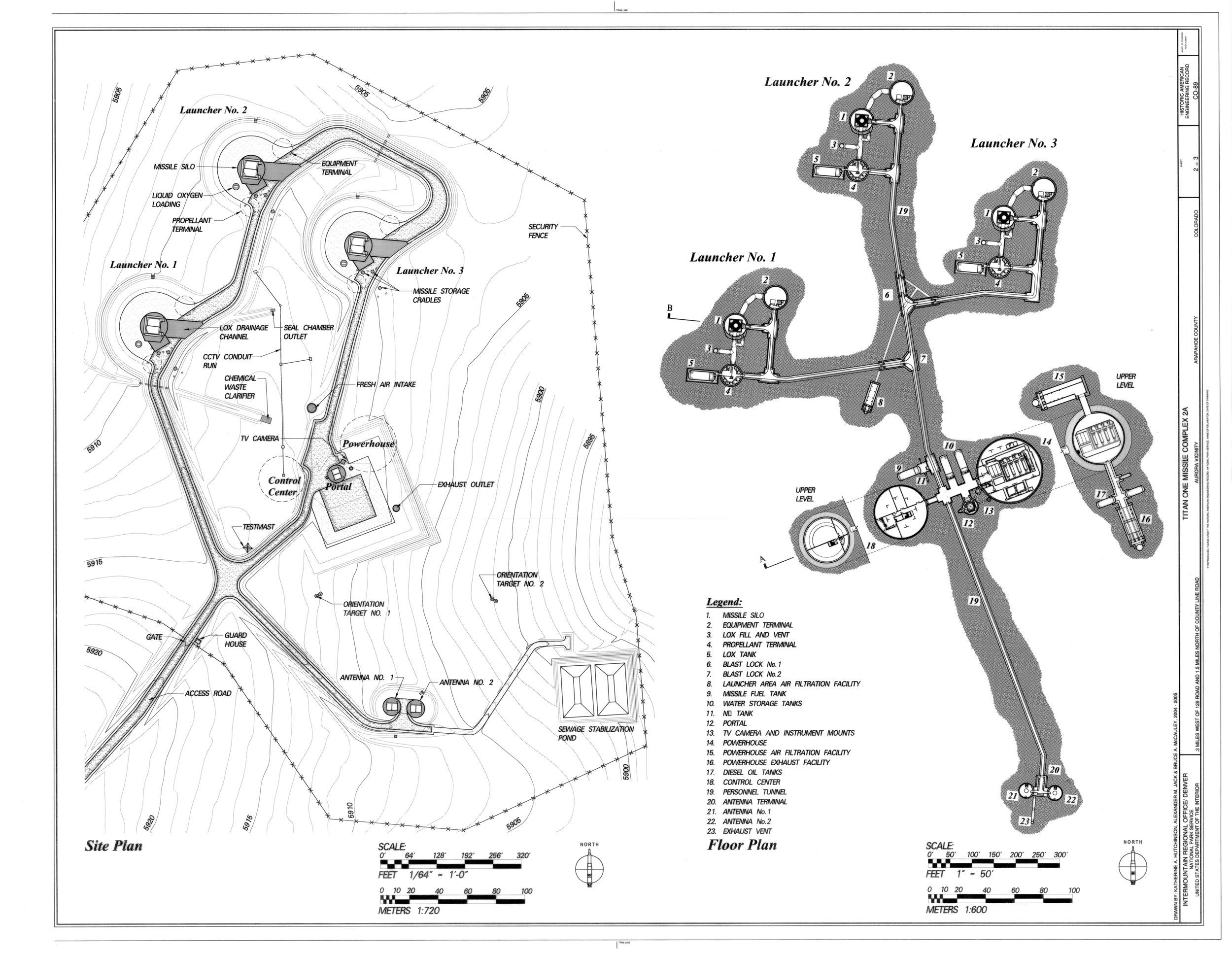
Titan Missile Complex site plan
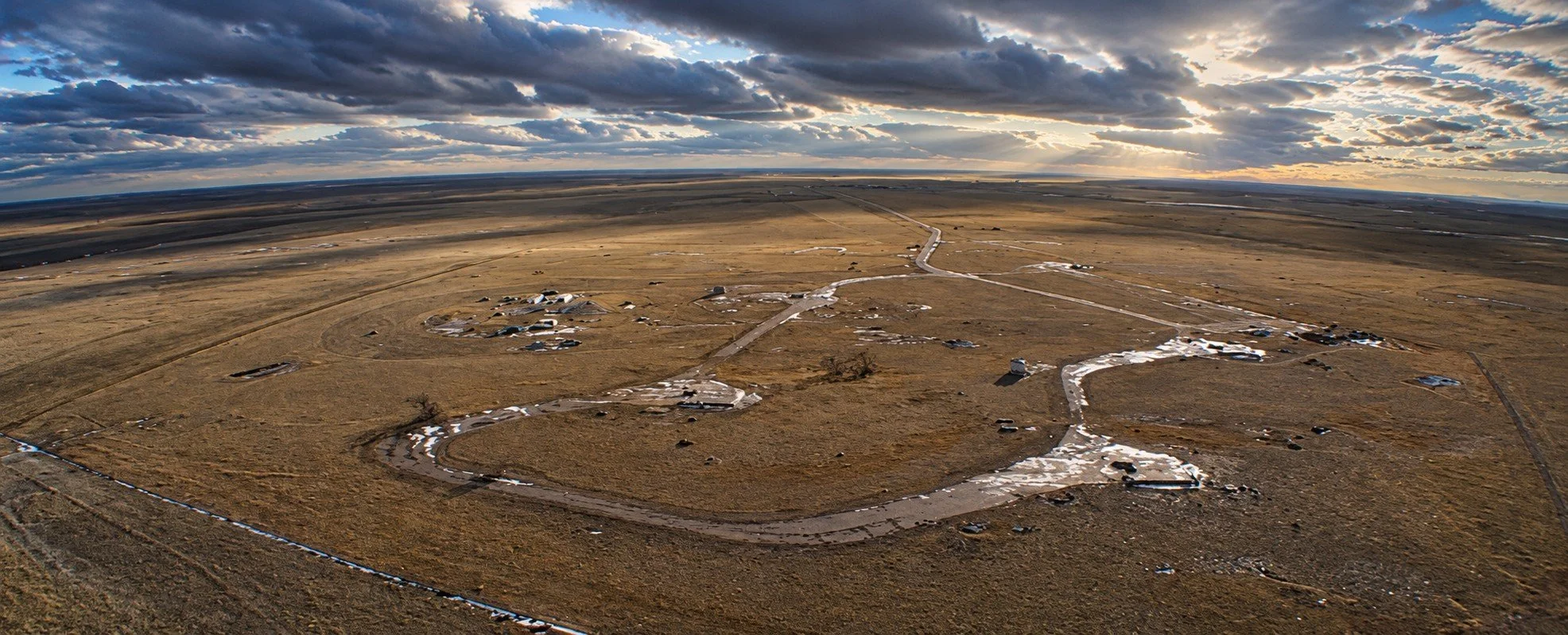
Titan Missile Complex site plan Aerial Photo
Abstract
This project investigates the spatial, environmental, and political afterlives of military infrastructure under conditions of climate destabilization. It examines the Titan I missile complex not as a historical artifact, but as an operative system—one whose material, geometric, and environmental properties can be reinterpreted as evidence of latent capacity.
Working at the intersection of architectural analysis and speculative reconstruction, the project treats the silo as both object of inquiry and site of intervention. Through spatial modeling, environmental simulation, and sectional reorganization, it reconstructs how a structure designed for nuclear launch can be recalibrated to support collective survival.
Architecture is deployed here as a form of forensic practice: assembling fragments—material, climatic, and territorial—into spatial arguments that expose how infrastructures persist, adapt, and can be reprogrammed. The project asks not what architecture will build next, but what existing systems already contain.
Context
The project is grounded in an evidentiary reading of climate change as a distributed and uneven process. Rather than a singular catastrophic event, collapse is traced through measurable conditions: rising temperatures, hydrological instability, infrastructural withdrawal, and patterns of forced migration.
These conditions produce spatial asymmetries. Certain populations remain insulated through technological and economic means, while others are exposed to systemic failure. Architecture, in this context, becomes a mechanism of selection—organizing who is protected, who is displaced, and how resources are distributed.
Parallel to these processes is a network of decommissioned military infrastructures across the United States. The Titan I missile silos—constructed in the early 1960s—were engineered for survivability under extreme conditions. Their thick concrete envelopes, subterranean depth, and autonomous systems register a form of embedded intelligence: thermal stability, structural redundancy, and environmental isolation.
The site in Aurora, Colorado is examined as a spatial archive. Its geometry and material composition are read not as fixed, but as variables capable of reinterpretation. The project operates on the premise that these structures constitute a pre-existing infrastructure for resilience—one that can be reactivated under new environmental and social conditions.
Methods
1. Spatial Reconstruction
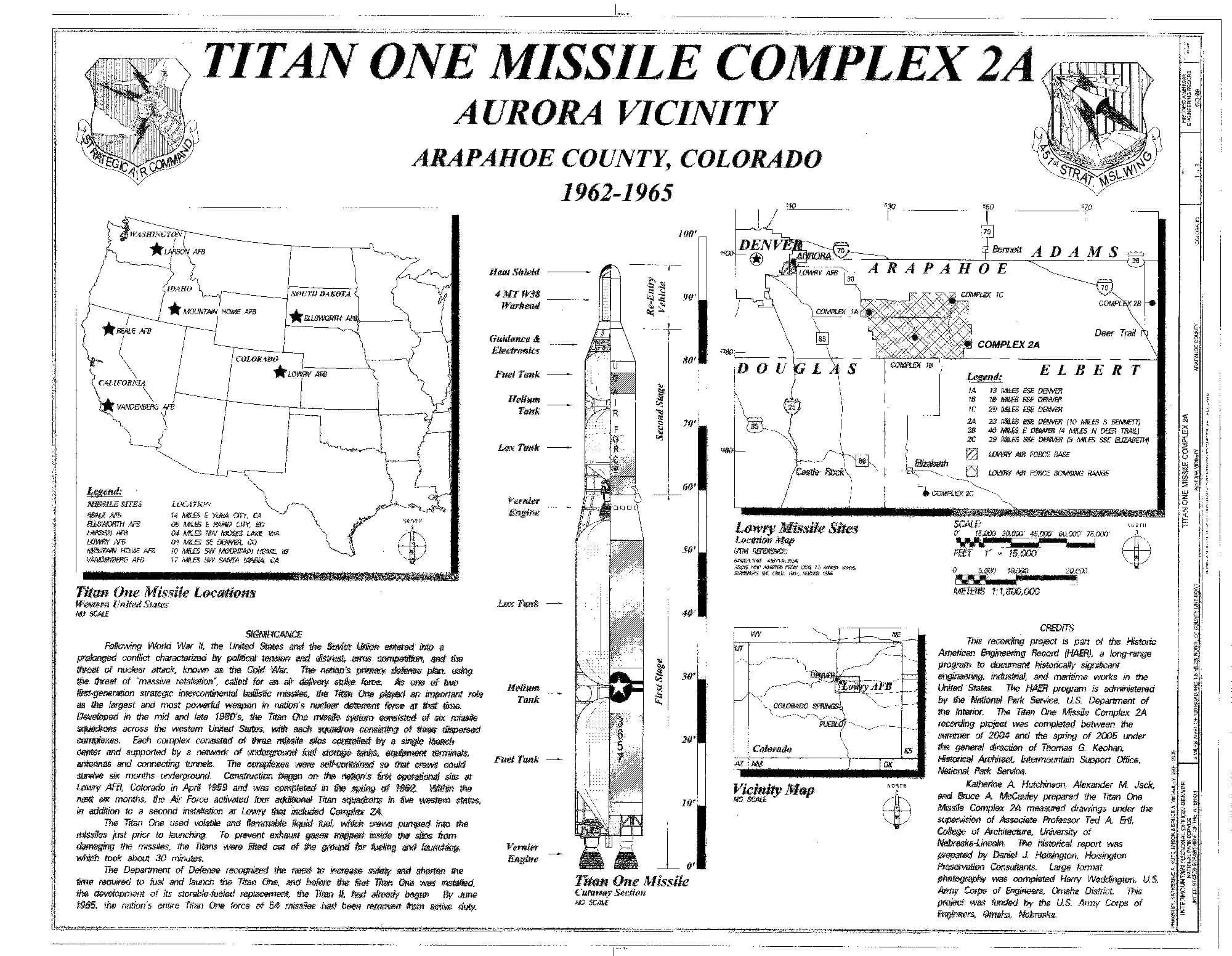
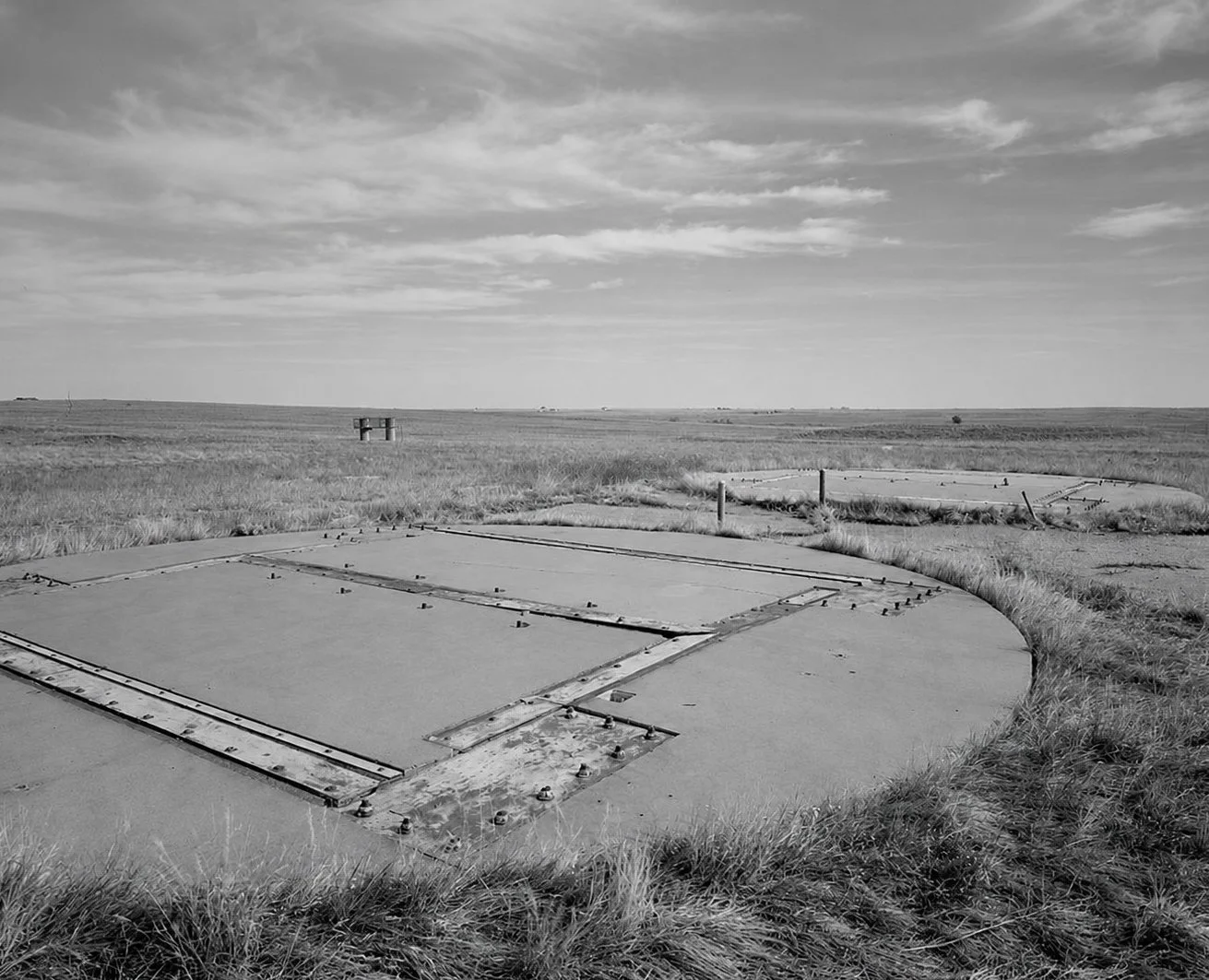
Archival drawings, satellite imagery, and typological comparisons are used to reconstruct the geometry of the Titan I complex. The silo is modeled as a continuous vertical system, emphasizing relationships between depth, enclosure, and circulation.
2. Environmental Forensics
Thermal mass, air movement, and solar exposure are analyzed to determine the silo’s capacity for passive climate regulation. The structure is treated as an environmental device rather than a static container.
3. Sectional Analysis
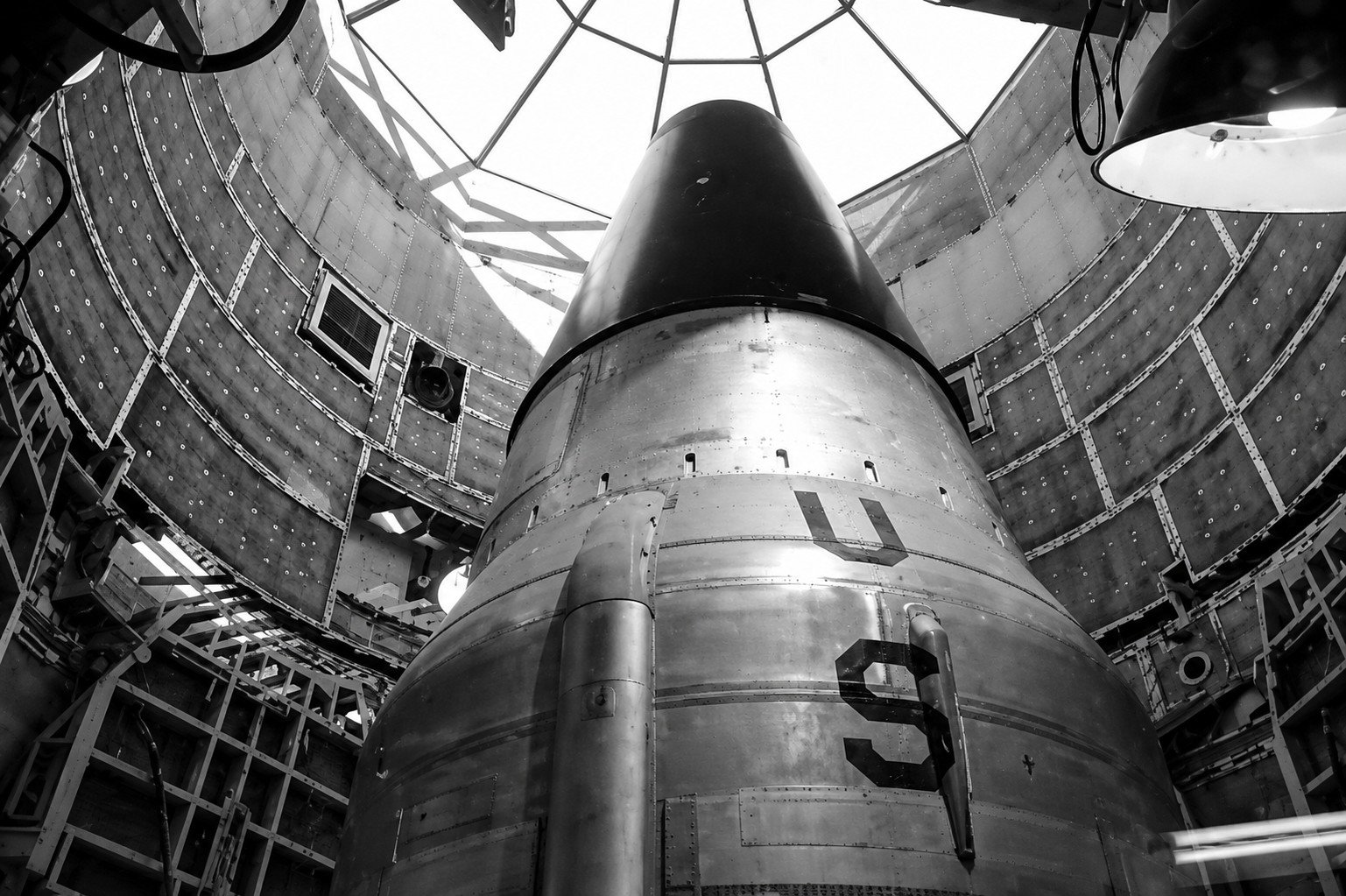
The project operates primarily in section. Vertical gradients—light, temperature, pressure, and occupancy—are mapped and recalibrated. Section becomes the primary instrument for reorganizing life within constraint.
4. Systems Mapping
Water, food, energy, and waste cycles are diagrammed as closed-loop systems. These flows are not supplementary but constitutive, generating spatial organization and social relationships.
5. Distributed Authorship
The silo is divided into six vertical zones, each designed independently yet interdependently. This fragmentation produces a negotiated architecture, where spatial decisions are contingent on adjacent conditions.
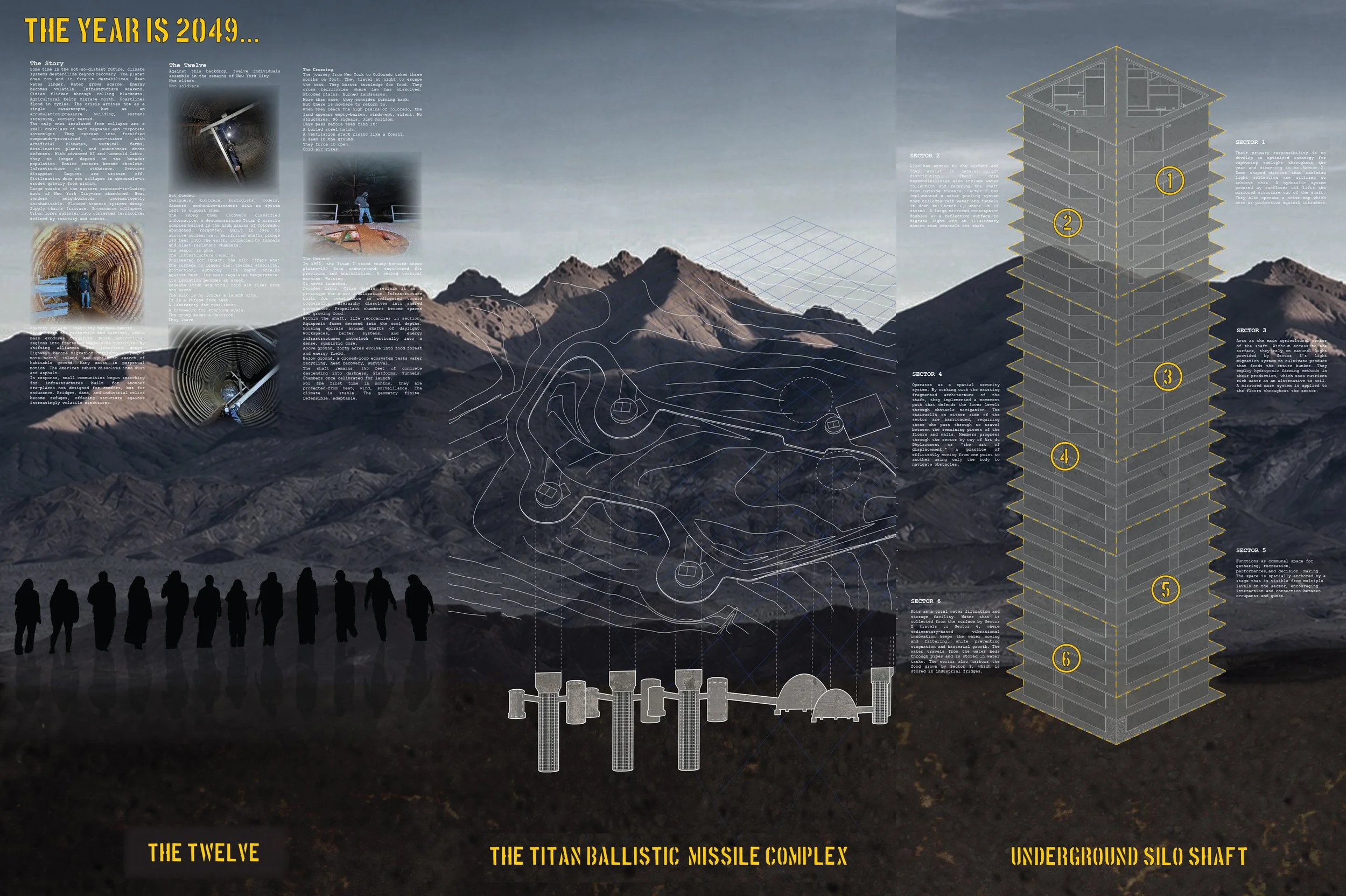
Story-line and Titan Ballistic Missile Complex in Aurora, Colorado
Story-line & Context
The Story
Some time in the not-so-distant future, climate systems destabilize beyond recovery. The planet does not end in fire—it destabilizes. Heat waves linger. Water grows scarce. Energy becomes volatile. Infrastructure weakens. Cities flicker through rolling blackouts. Agricultural belts migrate north. Coastlines flood in cycles. The crisis arrives not as a single catastrophe, but as an accumulation—pressure building, systems straining, society tested.
The only ones insulated from collapse are a small overclass of tech magnates and corporate sovereigns. They retreat into fortified compounds—privatized micro-states with artificial climates, vertical farms, desalination plants, and autonomous drone defenses. With advanced AI and humanoid labor, they no longer depend on the broader population. Entire sectors become obsolete. Infrastructure is withdrawn. Services disappear. Regions are written off. Civilization does not collapse in spectacle—it erodes quietly from within.
Large swaths of the eastern seaboard—including much of New York City—are abandoned. Heat renders neighborhoods intermittently uninhabitable. Flooded transit systems decay. Supply chains fracture. Governance collapses. Urban cores splinter into contested territories defined by scarcity and unrest.
Anarchy spreads. Stability becomes memory.
Groups form for protection and survival, while mass exoduses transform dense metropolitan regions into fractured wastelands controlled by shifting alliances and localized gangs. Highways become migration corridors as people move north, inland, and uphill in search of habitable ground. Many exist in perpetual motion. The American suburb dissolves into dust and asphalt.
In response, small communities begin searching for infrastructures built for another era—places not designed for comfort, but for endurance. Bridges, dams, and industrial relics become refuges, offering structure against increasingly volatile conditions.
The Twelve
Against this backdrop, twelve individuals assemble in the remains of New York City.
Not elites. Not soldiers. Not funded.
Designers, builders, biologists, coders, farmers, mechanics—dreamers with no system left to support them.
One among them uncovers classified information: a decommissioned Titan I missile complex buried in the high plains of Colorado. Abandoned. Forgotten. Built in 1962 to survive nuclear war. Reinforced shafts plunge 150 feet into the earth, connected by tunnels and blast-resistant chambers.
The weapon is gone. The infrastructure remains.
Engineered for impact, the silo offers what the surface no longer can: thermal stability, protection, autonomy. Its depth shields against heat. Its mass regulates temperature. Its isolation becomes an asset.
Beneath scrub and wind, cold air rises from the earth.
The silo is no longer a launch site.
It is a refuge from heat. A laboratory for resilience. A framework for starting again.
The group makes a decision.
They leave.
The Crossing
The journey from New York to Colorado takes three months on foot. They travel at night to escape the heat. They barter knowledge for food. They cross territories where law has dissolved. Flooded plains. Burned landscapes.
More than once, they consider turning back.
But there is nowhere to return to.
When they reach the high plains of Colorado, the land appears empty—barren, windswept, silent. No structures. No signals. Just horizon.
Days pass before they find it:
A buried steel hatch. A ventilation stack rising like a fossil. A seam in the ground.
They force it open.
Cold air rises.
The Descent
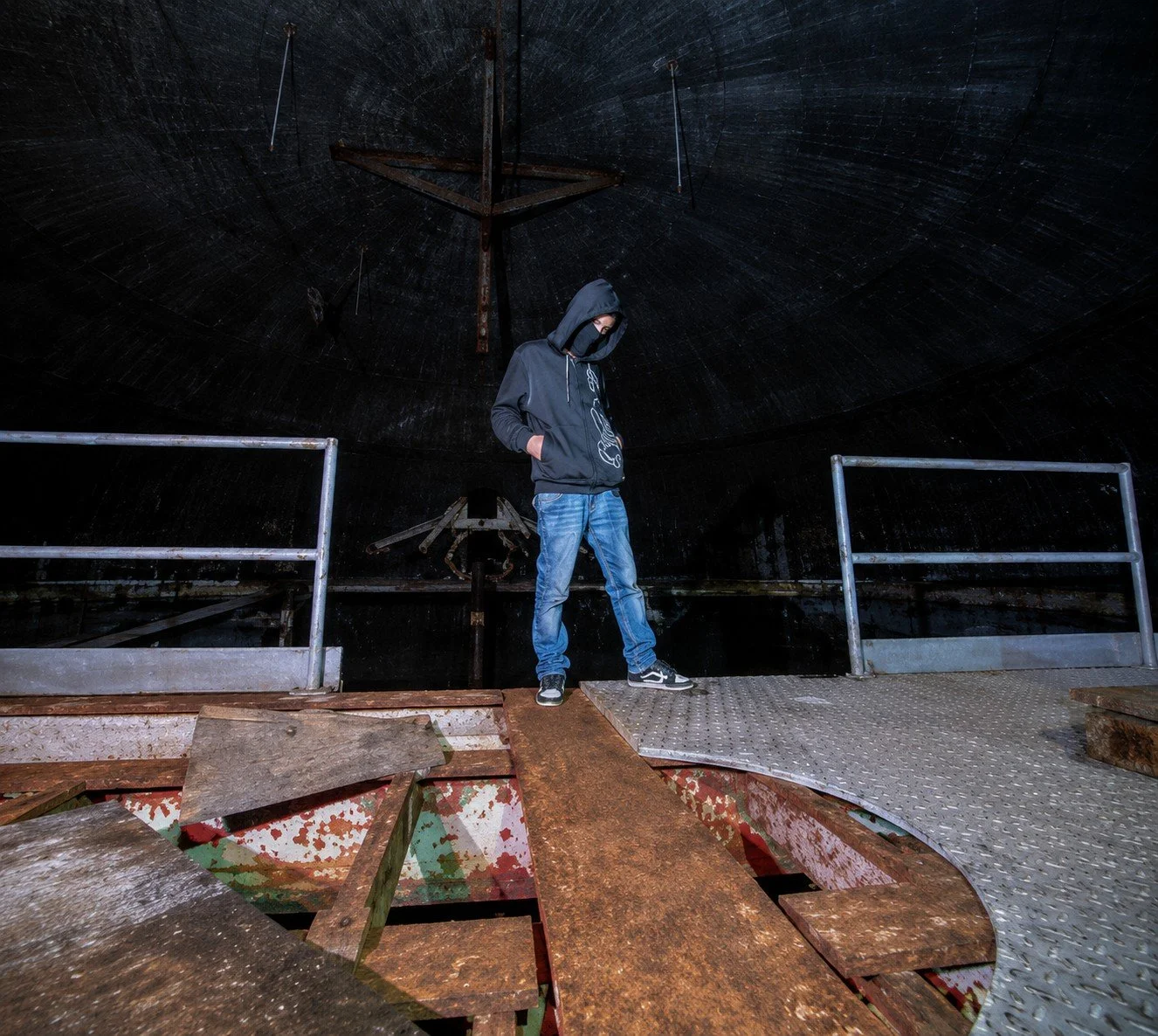
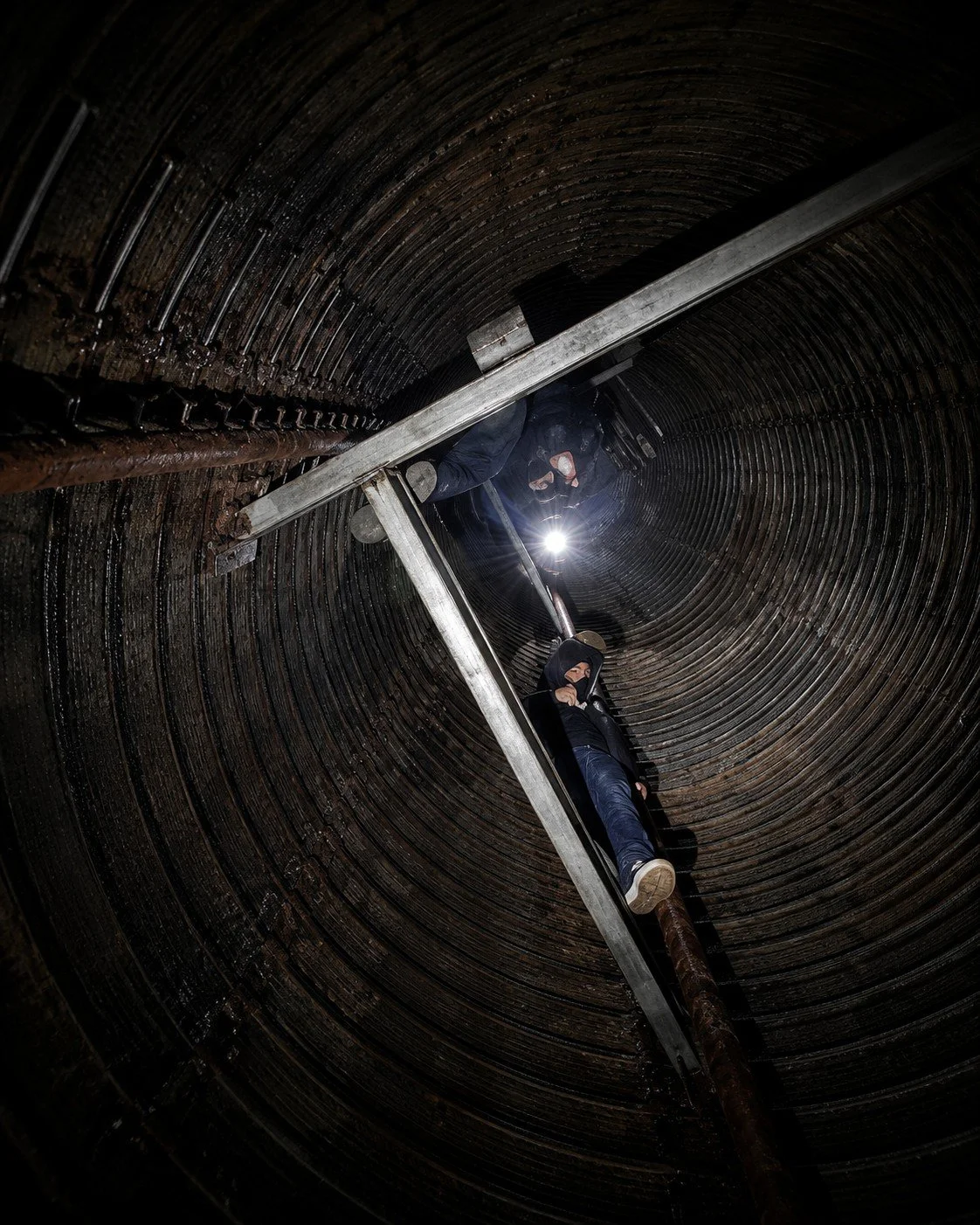
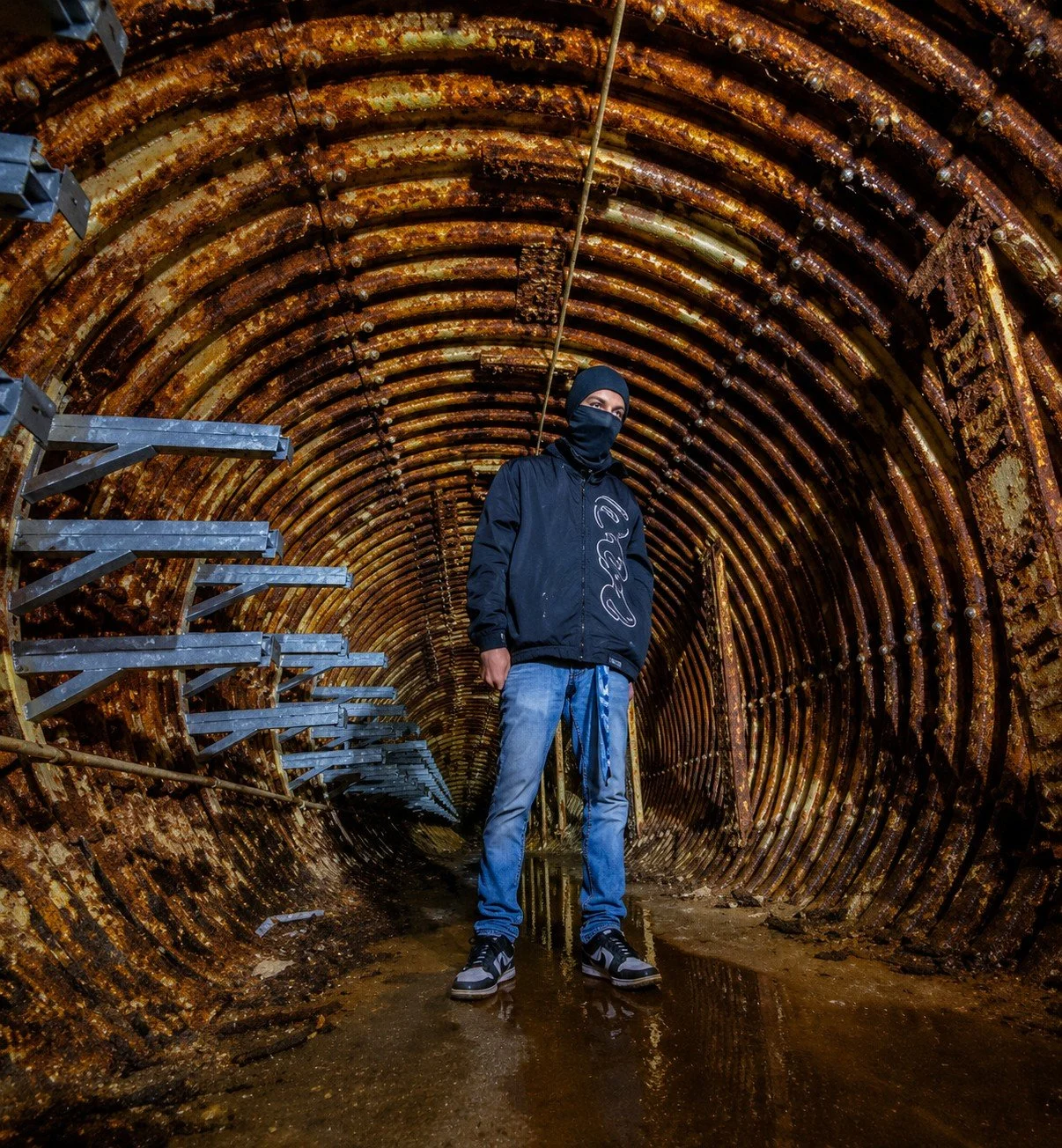
In 1962, the Titan I stood ready beneath these plains—150 feet underground, engineered for precision and annihilation. A sealed vertical machine. Waiting.
It never launched.
Decades later, Titan Makers reclaim it as a prototype for a new civilization. Infrastructure built for retaliation is redirected toward cooperation. Hierarchy dissolves into shared governance. Propellant chambers become spaces for growing food.
Within the shaft, life reorganizes in section. Aquaponic farms descend into the cool depths. Housing spirals around shafts of daylight. Workspaces, barter systems, and energy infrastructures interlock vertically into a dense, symbiotic core.
Above ground, forty acres evolve into food forest and energy field. Below ground, a closed-loop ecosystem tests water recycling, heat recovery, survival.
The shaft remains: 150 feet of concrete descending into darkness. Platforms. Tunnels. Chambers once calibrated for launch.
For the first time in months, they are protected—from heat, wind, surveillance. The climate is stable. The geometry finite. Defensible. Adaptable.
The silo is no longer a weapon.
It is a refuge. A laboratory. Infrastructure for the future.
The Twelve—now the Titan Makers—ask:
If the systems we depend on fail, how might architecture become the framework for beginning again?
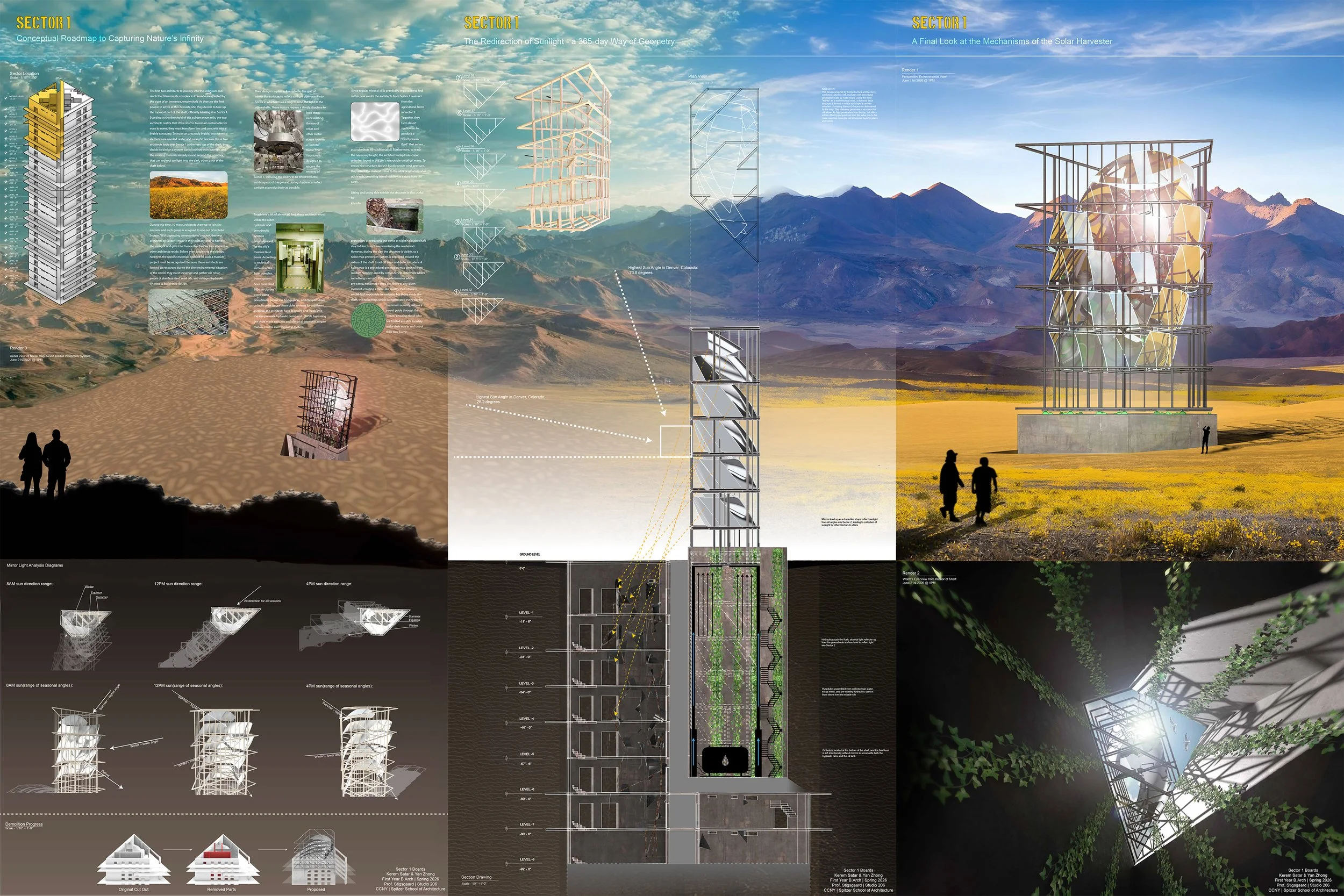
Sector 1: Kerem Satar & Yan Zhong
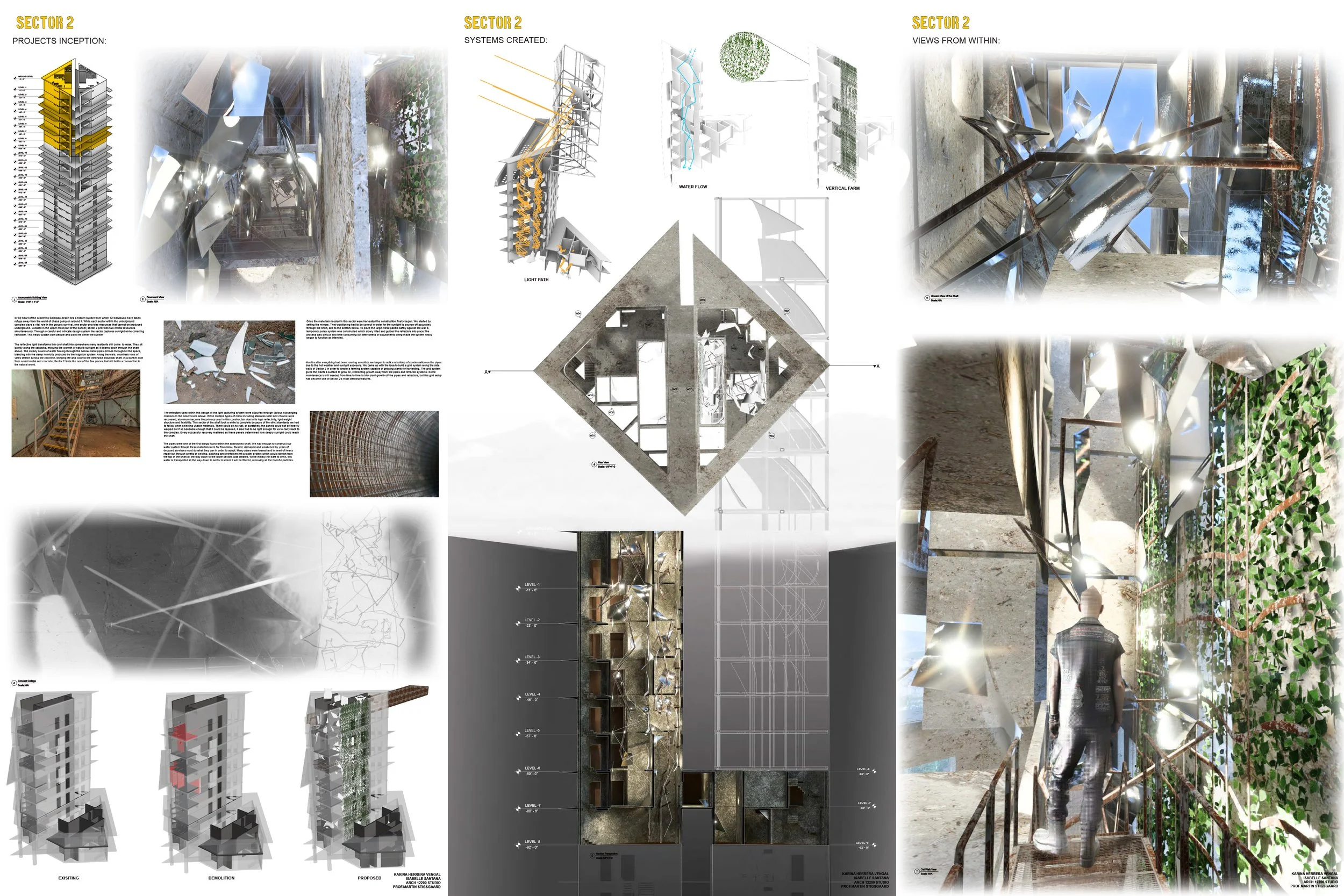
Sector 2: Karina Herrera Vengal & Isabelle Santana
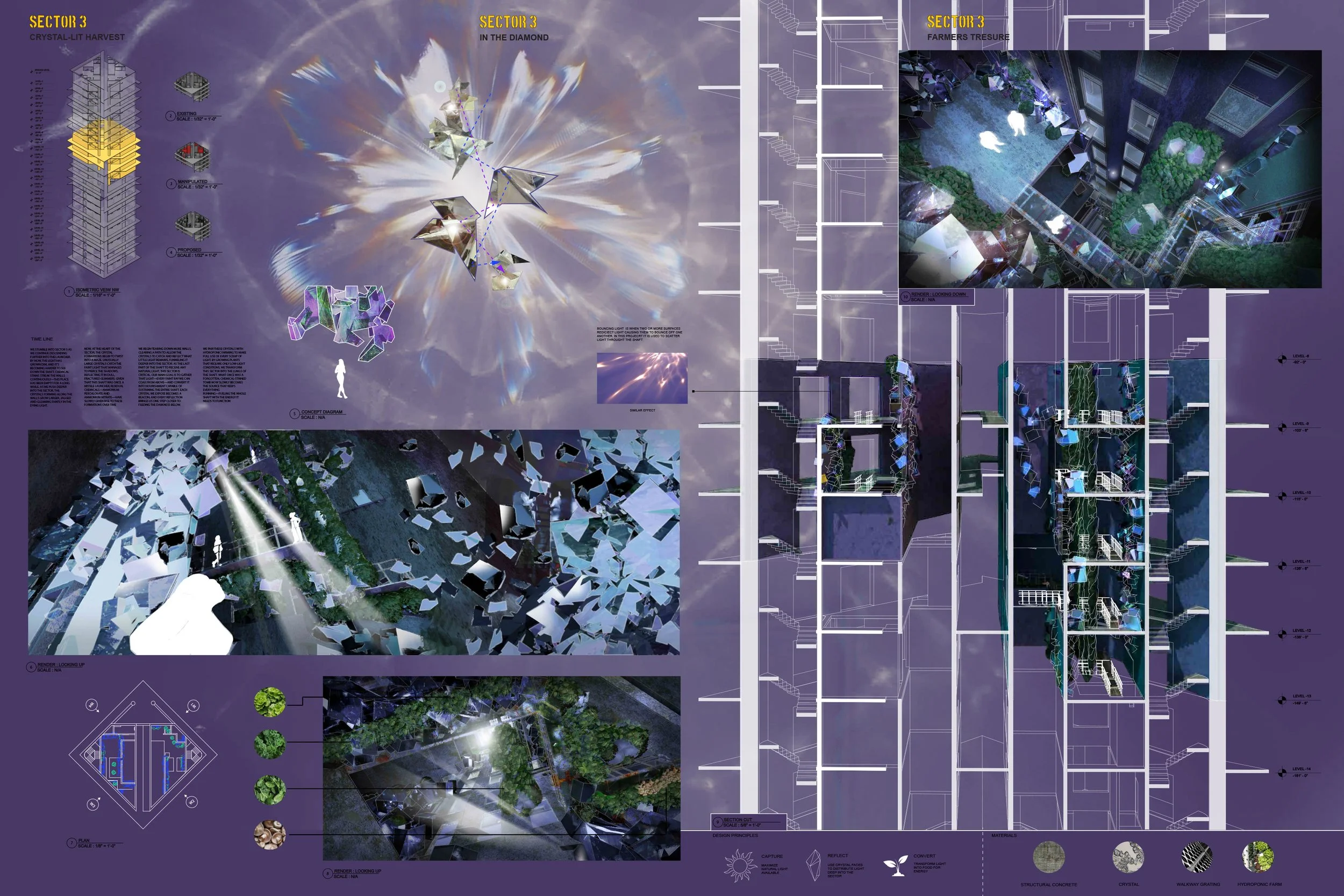
Sector 3: Danna Espinosa & Ashley Guzman
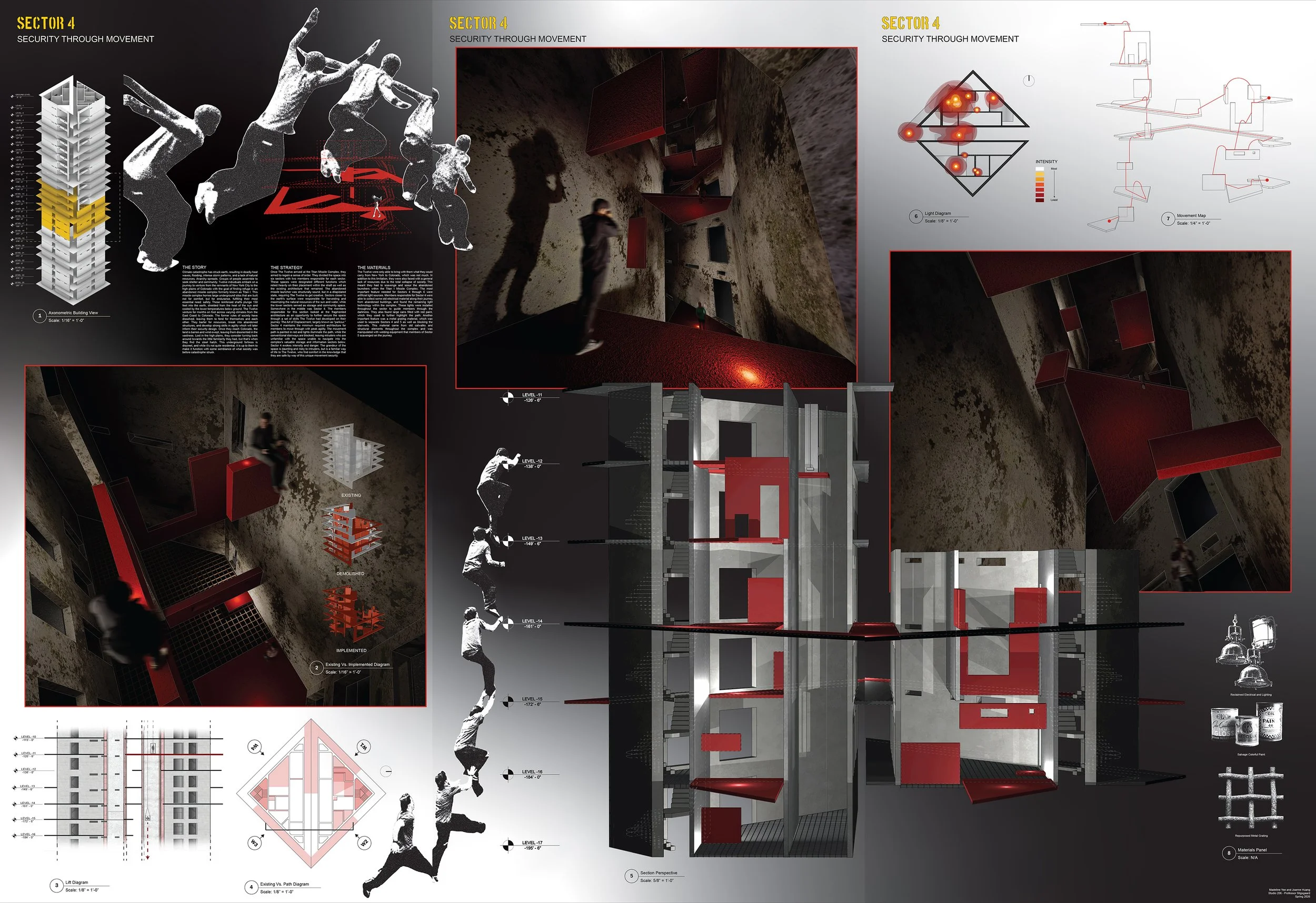
Sector 4: Madeline Yee & Joanne Huang
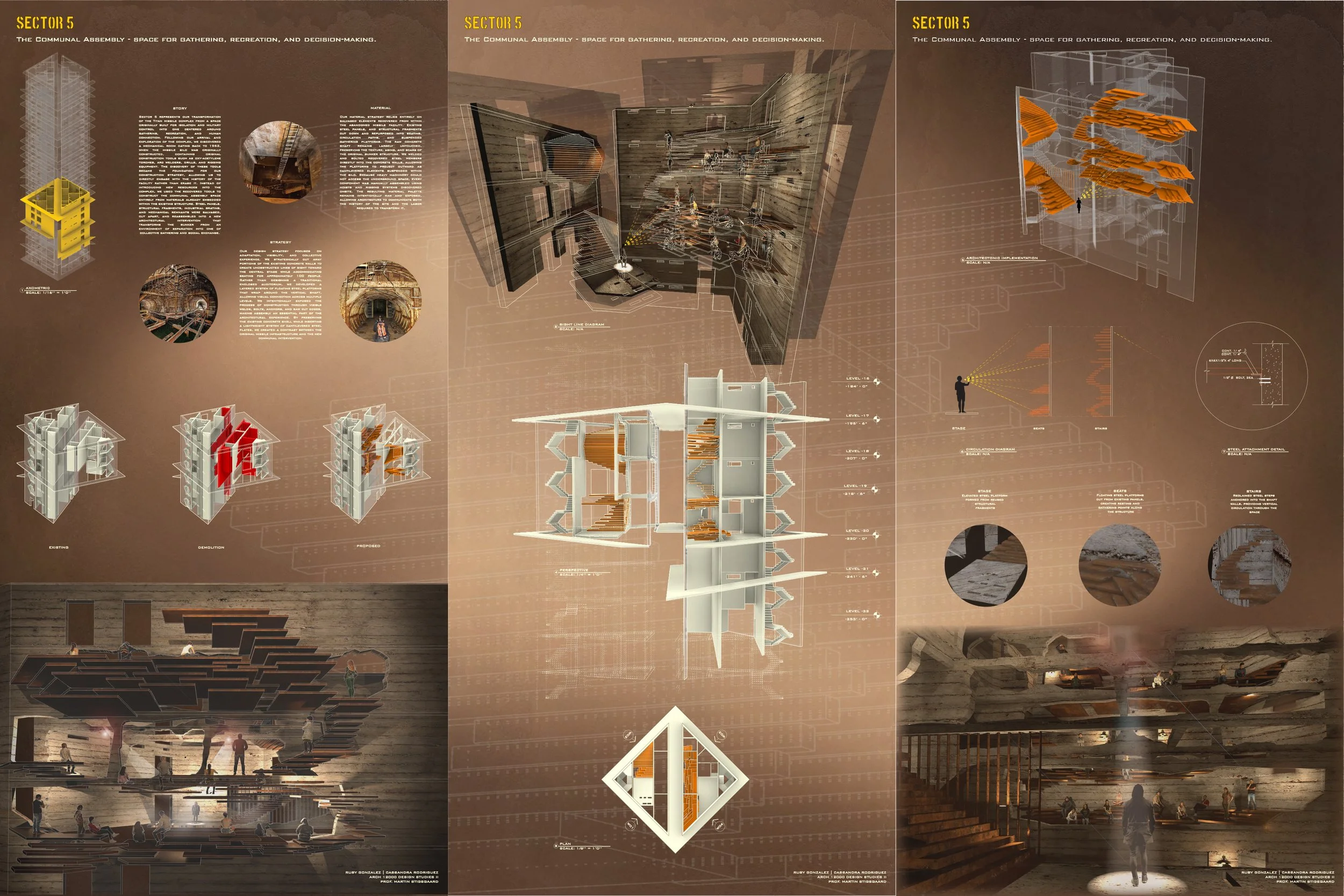
Sector 5: Rubidia Gonzalez & Cassandra Rodrigues
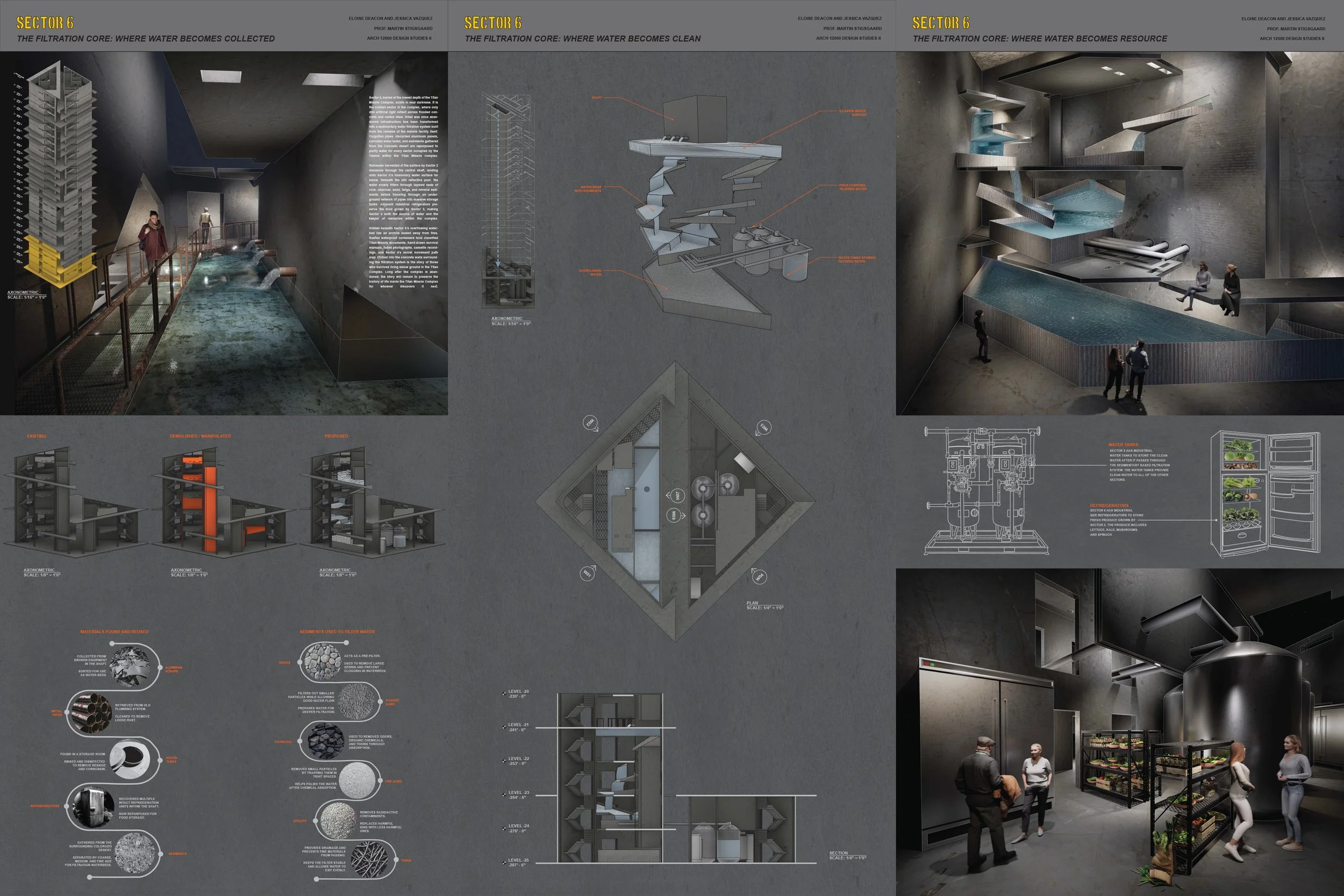
Sector 6: EloiseDeacon & JessicaVazquez
Findings / Evidence
1. The Silo as Environmental Apparatus
The structure’s depth and mass produce measurable thermal stability. Temperature differentials between surface and subsurface conditions establish the silo as a passive climate regulator, reducing dependency on external energy systems.
2. Residual Capacity
Military infrastructures are not obsolete; they contain residual performance. Structural redundancy, blast resistance, and spatial autonomy constitute a form of latent resilience that can be reactivated.
3. Section as Governance
Vertical organization produces a hierarchy of access, visibility, and resource distribution. Control is no longer centralized but embedded within spatial relationships—who occupies upper zones of light, who depends on shared systems below.
4. Infrastructure as Form
Water collection, aquaponics, and energy systems are not concealed networks but primary spatial drivers. Architecture emerges as a consequence of environmental and logistical necessity.
5. Psychological Thresholds
Extended habitation in enclosed environments reveals limits of perception, orientation, and social cohesion. Light penetration, material differentiation, and spatial sequence become critical to sustaining cognitive and emotional stability.
6. Surface / Subsurface Interface
The 40-acre surface operates as a productive field—supporting food systems, energy generation, and atmospheric exchange. The boundary between above and below ground becomes a controlled interface rather than a fixed division.
7. Reprogramming of Violence
The silo’s original function—nuclear deployment—is spatially inverted. Systems calibrated for speed, precision, and destruction are reoriented toward slowness, maintenance, and care.
8. Collective Dependency
No segment operates independently. Water, energy, and circulation systems create enforced interdependence, producing a form of governance structured through necessity rather than ideology.
9. Architectural Evidence as Argument
Drawings, models, and simulations function as evidentiary claims. They do not represent a future condition but construct a verifiable argument about what the existing structure can support.
10. Continuity of Systems
The project demonstrates that collapse does not erase infrastructure. Systems persist, decay, and can be reactivated. Architecture operates within this continuity, reinterpreting rather than replacing.
Studio Directive
The project is framed as an investigation:
Identify the latent capacities embedded within the silo.
Reconstruct its spatial and environmental logic.
Propose an intervention that operates within, not against, these constraints.
Each team designs a vertical segment as both independent system and collective dependency, integrating structure, environment, and social organization into a coherent spatial argument.
Conclusion
Titan Makers positions architecture as a form of reconstruction—assembling fragments of existing systems into new configurations of life.
The missile silo is not reimagined through metaphor but through evidence:
its mass, its depth, its environmental performance, its geometry.
What emerges is not a utopia, but a demonstration - that infrastructures designed for destruction can be recalibrated, and that architecture can operate as a method for revealing and redirecting the capacities already embedded in the built world.
In this sense, the project does not propose a future. It reconstructs a possibility that already exists.
Credits
Studio STIGSGAARD Research Program
Collaborators: CCNY Studio, Ashley Guzman-Fernadez, Cassandra Rodriguez, Danna Espinosa, Eloise R Deacon, Isabelle I Santana, Jessica Tolentino Vazquez, Joanne Huang, Karina Herrera Vengal, Kerem T Satar, Madeline Yee, Rubidia E Gonzalez, Yan Zhong
Location: Aurora, Colorado
Year: 2026
Contact: info@architecturefieldlab.org